IMPACT REPORTING
Write a sustainability report people actually read

IMPACT REPORTING
Write a sustainability report people actually read
Impact reporting is how organisations translate sustainability efforts, data, and initiatives into a clear, credible story one that holds up to customers, investors, regulators, and your own team. Done well, it not only shows the impact of your CO₂ reduction, social initiatives, and sustainable business practices, it also supports better decisions going forward, not just external transparency.
At NEWKINDS, we’ve guided organisations of every size through this process for over 15 years, from large, complex companies like Albert Heijn, bol.com, and Etos, to smaller, hands-on teams building their first report. Whether you need a report aligned with CSRD, VSME, or B Corp, or simply want a clear, honest account of your impact, we help you structure the data, shape the narrative, and produce something people actually read.
Impact reporting helps organisations understand, structure, and communicate the environmental and social impact they are making. They can serve different frameworks and audiences depending on the organisation’s needs — from voluntary storytelling for customers and employees, to structured disclosures aligned with regulatory standards like the CSRD (Corporate Sustainability Reporting Directive), the VSME standard for SMEs, or certification frameworks such as B Corp. In all cases, the goal is the same: turning sustainability data into a report that is credible, clear, and genuinely usable — internally for decision-making, and externally for transparency.
“Good impact reporting doesn’t just show what you’ve done — it helps you improve what comes next.”
We move through the report in four stages: first defining the goal, audience, and scope together, then mapping available data and closing the gaps that matter most. From there, we translate that data into insights, cases, and a clear narrative, and – optionally – bring in our communication and design team to turn it into a report that’s easy to navigate.

We take the lead throughout the full process:
You take the lead, while we provide structure and guidance.
We provide:
A free template to start your first impact report in just 6 steps.
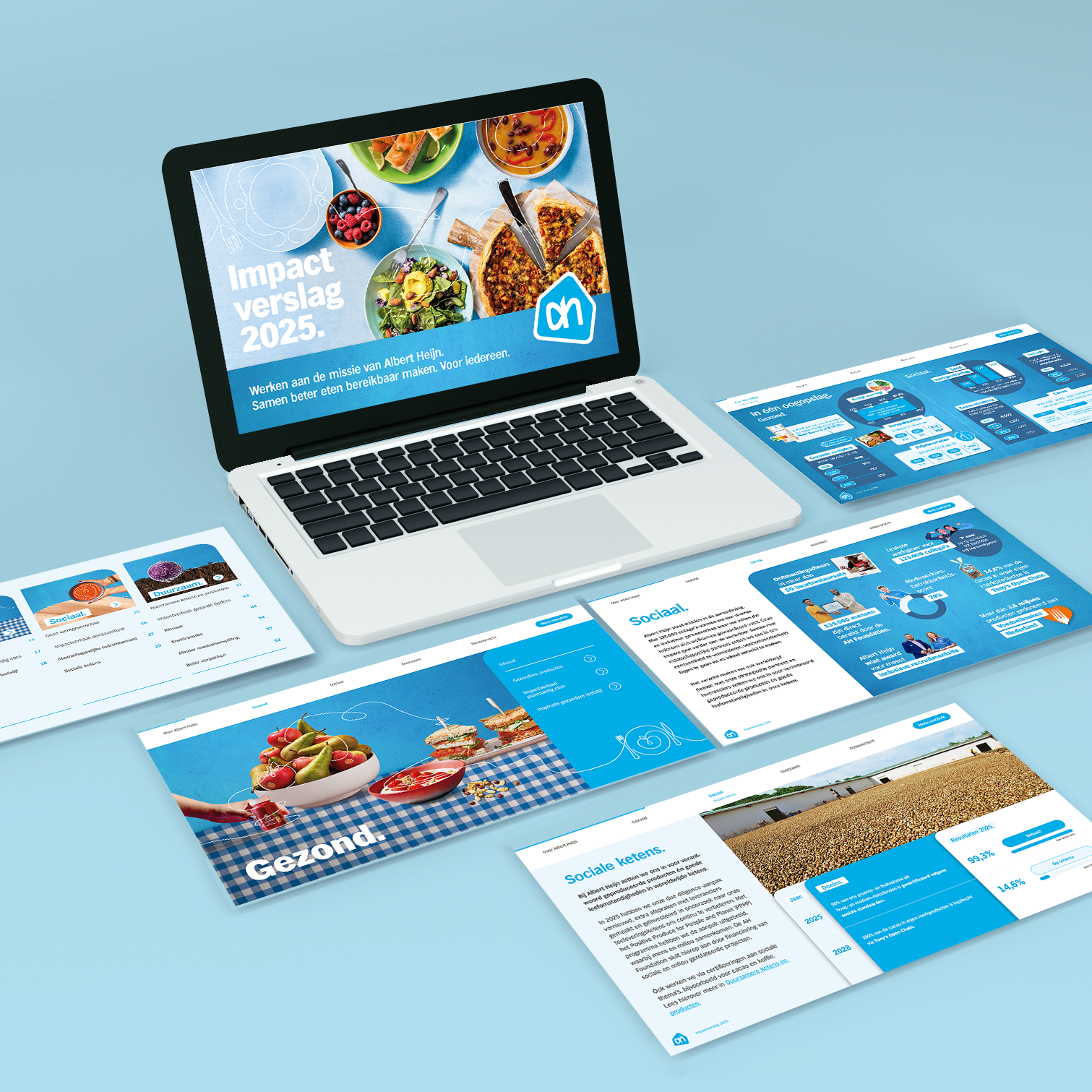
At NEWKINDS, we’ve guided organisations of every size through this process for over 15 years — from large, complex companies like Albert Heijn, bol.com, and Etos, to smaller, hands-on teams building their first report.

We don’t start with data, we start with what matters for your organisation. Based on your strategy, activities, and stakeholder expectations, we determine which impact areas are relevant. From there, we identify what data is already available, what is missing but relevant, and what is realistic to collect. The goal is not to collect everything, but to focus on data that supports your strategy and helps you make better decisions.
We work with different frameworks depending on what fits your organisation and context, such as VSME, CSRD, B Corp, and others. We don’t start from the framework — we start from your situation, then align the reporting with relevant standards where needed.
The VSME (Voluntary Sustainability Reporting Standard for SMEs) is a simplified reporting standard developed by EFRAG and recommended by the European Commission for small and medium-sized companies that fall outside the scope of the CSRD. It’s built around two modules — a Basic module covering minimum disclosures, and a Comprehensive module for more detailed reporting — so you only report what’s relevant (“if applicable”), without the complexity of full CSRD reporting. It’s a good fit if your customers, banks, or larger partners in your value chain are asking you for sustainability data, but you don’t fall under mandatory CSRD reporting yourself.
The VSME is voluntary and designed to be flexible — you’re not required to disclose every data point, only what’s applicable to your organisation. We help you determine which parts of the Basic and Comprehensive modules make sense for you, so the report stays proportional to your size and maturity rather than becoming a compliance exercise.
CSRD (Corporate Sustainability Reporting Directive) is mandatory for large, listed, and certain other qualifying companies, and requires reporting against the detailed ESRS standards, including a double materiality assessment. VSME is voluntary, simpler, and designed specifically for SMEs and micro-companies that fall outside CSRD’s scope — often because a larger customer or bank in their value chain is asking for sustainability information. In practice, VSME is best understood as a lighter, proportional alternative to CSRD, not a stepping stone you’re required to take before it.
Yes. Scope questions like this are exactly where we start. We look at your size, structure, and where the reporting requests are coming from (customers, banks, investors, or regulation) to determine which framework — or combination — actually applies to you, before we start building anything.
Often, yes — there’s overlap in the underlying data (emissions, labour practices, governance), so a well-structured report can support multiple purposes. But each framework has its own specific requirements and scoring logic, so we map this explicitly rather than assuming one report automatically satisfies another framework.