
The VSME is the European standard for voluntary sustainability reporting: one fixed format to share information about your energy use, your people and your policies.
Are customers or your bank asking for sustainability data and you are not sure what to send them? Or do you want something ready before the question comes? We help you collect the right data once and turn it into a report you can reuse.
What is VSME?
The VSME standard was developed by EFRAG, the European Commission’s technical advisor on sustainability reporting. It gives companies outside the mandatory CSRD scope a standard format to answer sustainability questions from customers, banks and investors. Instead of filling in a different questionnaire for every client, you report once and share the same package.
The standard is built from two modules. A VSME Basic Module with around 50 datapoints for companies starting out, and a VSME Comprehensive Module for those who want to report more.
Worth knowing: reporting is voluntary, but that does not always feel voluntary in practice. Once a major customer makes sustainability data part of their supplier selection, the choice is made for you.
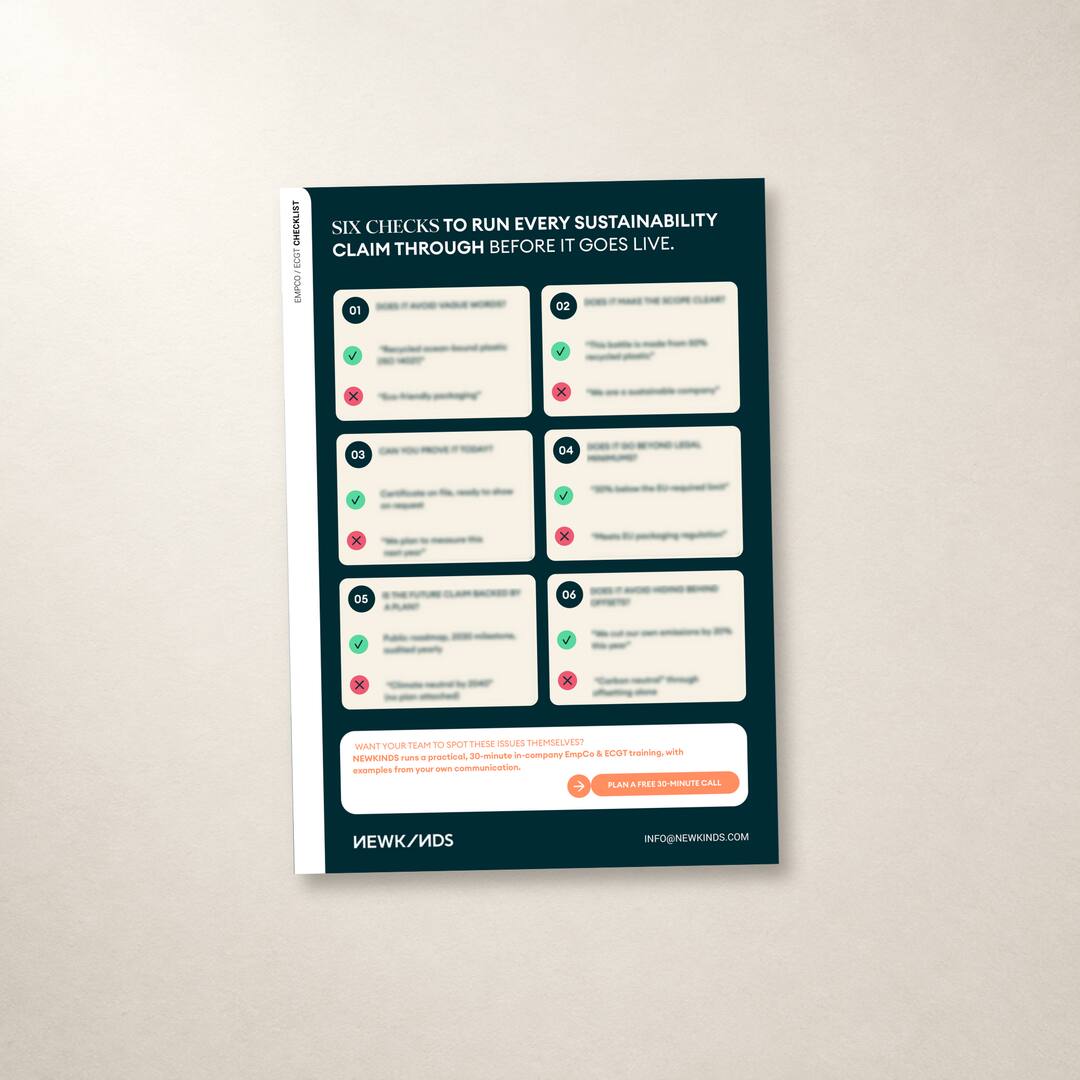
Download your VSME checklist
Six questions to aks yourself before publishing your claim.
Who is the VSME for?
The VSME was originally designed for SMEs: non-listed companies with fewer than 250 employees. Since the 2026 update, the standard, now officially called the Voluntary Standard, is open to any company outside the mandatory CSRD scope and is built for companies with up to 1,000 employees, listed or not. That wider scope is exactly why the name changed.
There is a detail here that works in your favour. From financial year 2027, companies subject to the CSRD cannot require more sustainability information from a company with 1,000 employees or fewer than the voluntary standard asks for. So the standard is not just a format to report in, it is also a ceiling on what your customers may request. If you have ten employees or fewer, you get extra room: some environmental disclosures in the Basic Module are optional for you.
Our approach
1
Baseline
We look at what your customers and financiers are actually asking, what data you already have, and which module fits your situation. That tells you where the gaps are before you start filling anything in.
2
Data collection
We help you get the numbers out of the systems and departments where they live, from energy bills to HR records. Where possible we use templates and formats you can reuse next year, so the second round takes a fraction of the time.
3
Reporting
We turn the data into a report that meets the standard and that your customers can actually work with. And we make sure your team knows how to update it themselves.
4
Improve
A report is a starting point, not the finish line. We help you use the data to set targets and improve year on year, and to move to the Comprehensive Module when your customers ask for more. And if your company ever grows towards the CSRD thresholds, the foundation is already in place.
What do you report under the VSME?
The standard covers environment, social and governance topics, translated into questions about your daily operations rather than abstract ESG language. Most of the answers already exist somewhere in your business.
| Topic | What you need | Where to find it |
| Energy | Gas and electricity use | Energy bills |
| Emissions | Energy, fuel, mobility | Finance, fleet |
| People | FTE, turnover, safety | HR or payroll |
| Waste | Volumes per stream | Waste processor |
| Governance | Policies and responsibilities | Management |
The Comprehensive Module adds topics such as strategy, reduction targets and human rights in your supply chain. Which module you choose depends on what your customers ask and how far you want to take it.


From VSME to Voluntary Standard, what changed in 2026?
The standard got a new name and a stronger legal basis. On 3 July 2026 the European Commission adopted it as a delegated regulation under the name Voluntary Standard, published on 21 September and in force since 24 September 2026.
Three things changed. The scope widened from non-listed companies up to 250 employees to all companies up to 1,000 employees. The status moved from a recommendation to EU law, which is what makes the value chain cap enforceable. And the standard itself became more compact, 30 pages instead of 66, with the examples moved to the EFRAG website.
Most sources online still describe the old version. If you read somewhere that the VSME stops at 250 employees, that information is out of date.
Why choose NEWKINDS for your VSME report?
We designed our coaching, tools and training specifically for SMEs, because that is where sustainability tends to feel the most overwhelming. So we keep your VSME report as light as it can be: we focus on the datapoints your customers actually ask for and use templates you can reuse next year. Because we coach rather than take over, the second report is one your own team can produce. And since our sustainability services run from strategy to certification, you can build on the same data when you are ready for the next step.
Not sure where to start? Plan a free 30-minute call with Margreet and we will go through your situation together, no strings attached.
Frequently asked questions about VSME
-
No. Reporting under the VSME is voluntary and there is no legal obligation to do it. In practice it can still become necessary, because customers, banks and investors increasingly make sustainability data part of their selection process.
-
Yes. On 3 July 2026 the European Commission adopted the standard as a delegated regulation under the name Voluntary Standard, replacing the VSME recommendation from 2025. The content stayed largely the same, but the scope widened to companies up to 1,000 employees. Most people still say VSME.
-
The CSRD is mandatory for large companies and requires extensive reporting under the ESRS, including a double materiality analysis and external assurance. The VSME is voluntary, far lighter, and designed for companies outside that scope. Read more about what the CSRD requires and who it applies to.
-
No. Companies subject to the CSRD cannot require more sustainability information from a company with 1,000 employees or fewer than the voluntary standard asks for. A VSME report is therefore also a reasonable answer to a request that goes further.
-
No. Unlike CSRD reporting, the VSME does not require an auditor to verify your report. That keeps the cost down, but it also means the quality of your own data matters more.
-
That depends on how much of your data is already organised. The reporting itself is rarely the bottleneck. Collecting numbers from finance, HR and facilities takes the most time in the first year, and considerably less in the years after.